
Restaurant franchises often grow on inconsistent technology: different POS platforms, mixed Wi‑Fi setups, and local IT providers at each site. That increases operational risk, making outages during peak service more likely, weakening PCI‑DSS and data protection controls, and complicating reporting across the franchised estate.
A brand standard IT model changes this. By defining one architecture for network, POS, cloud systems, and security – then deploying it across every franchise location – franchisors (and franchisees) gain predictable performance, consistent guest experience, and clearer evidence of compliance.
When combined with managed restaurant IT services, time to resolution is lowered as are support costs per site. Guesswork is removed from new openings and refurbishments.
For operations and IT leads, the priority is to move beyond ad‑hoc fixes:
- audit the current estate,
- design a reference architecture,
- embed standards into franchise onboarding, and
- work with a single restaurant IT partner to implement and maintain that model at scale.
When a franchise restaurant’s technology fails during peak service, everything slows down.
Orders stack up, payment queues grow, staff switch to manual workarounds, and guests leave with a poor impression – even if the food and team are the same as yesterday.
In many restaurant franchises, those incidents are more likely because every site runs its own mix of POS, Wi‑Fi, and local IT providers, so the estate is difficult to support, difficult to secure, and difficult to scale.
For franchisors and multi‑site operators, another local fix will not solve that pattern. You need a brand standard IT model for your restaurant franchise: one defined architecture for restaurant IT support, rolled out consistently across locations and backed by a managed IT partner who understands hospitality operations.
Why “every site is different” stops restaurant franchising working
Restaurant franchising relies on predictability. Guests expect a consistent customer experience from the ordering journey, payment options, and digital touchpoints whether they’re in your original flagship or a brand-new suburban site.
If each restaurant franchisee gets to choose their own technology, that predictability disappears. From an operations and IT standpoint, four issues keep recurring:
- Restaurant support becomes harder: IT teams – in‑house or outsourced – must navigate different systems and configurations in every restaurant, which reduces first‑time fix rates and increases resolution times
- Brand experience fragments: Digital touchpoints vary between sites, from whether contactless works to how reliable online ordering feels, so guests see an uneven brand
- Security and compliance weaken: PCI‑DSS and data protection controls are difficult to apply consistently when each location has its own network design, POS choice, and local suppliers.
- Data becomes unreliable: Estate‑wide reporting depends on combining data from multiple systems in different formats, which slows decision‑making and reduces confidence in the numbers.
As your network grows, those issues scale with you. Without multi‑site restaurant IT brand standards, every new franchise adds another variation to manage rather than another predictable location to support.
What a brand standard restaurant IT model looks like
A brand standard IT model is a defined architecture for each restaurant, not just a list of preferred vendors. It explains how networking, POS, cloud platforms, and security fit together into one repeatable design.
For a typical restaurant franchise, that architecture normally covers:
- Network infrastructure: A standard router and switch design, with VLANs separating payment traffic, kitchen systems, back‑office, and guest Wi‑Fi so performance and segmentation are consistent everywhere.
- POS and payment systems: One or two approved POS platforms with agreed hardware, payment terminals, software versions, and update policies, so you can test and support a small number of known configurations.
- Kitchen and front‑of‑house technology: Defined options for kitchen display systems, printers, handheld ordering devices, and table‑side payment, documented and tested as an integrated restaurant technology stack.
- Cloud services and integrations: Standard platforms for reservations, delivery partners, inventory, HR, and accounting, with clear integration patterns into POS and financial systems – ideally delivered as restaurant cloud computing solutions rather than fragmented tools.
- Security and compliance controls: Baseline requirements for network segmentation, endpoint protection, logging, backups, and access management, designed to support PCI‑DSS and data privacy across the estate.
- Monitoring and restaurant IT support: Central monitoring of key systems, defined alert thresholds, and restaurant IT support aligned with restaurant trading hours, including evenings and weekends.
With that architecture in place, opening or refurbishing a restaurant becomes a repeatable process. You know what is being installed, how it will be configured, and which team is responsible for keeping it working during service.

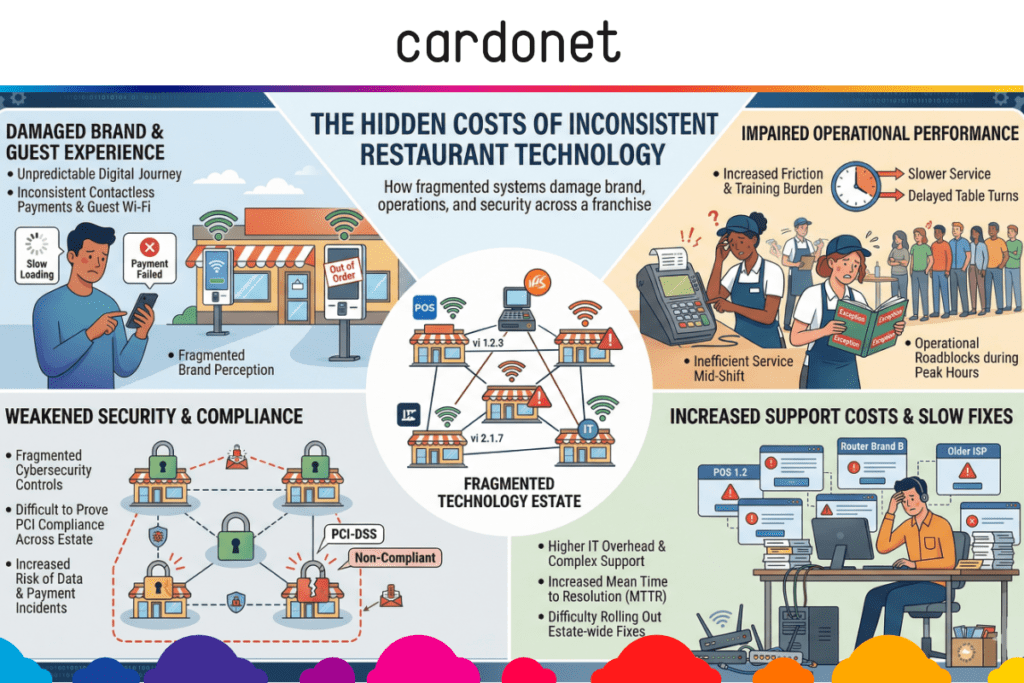
How inconsistent restaurant technology damages your brand and operations
Local variations can appear manageable when you look at one or two sites in isolation. Across a full franchise estate, they steadily undermine performance and control.
Brand and guest experience
Guests encounter technology from the moment they book to the moment they leave feedback. If some locations cannot process contactless payments reliably, others have slow or fragile online ordering, and some offer poor or insecure Wi‑Fi, guests experience your brand as unpredictable.
Operational performance in service
Different systems also add friction to day‑to‑day operations as members of your team who move between locations must adapt to different POS layouts and processes. This means training materials need site‑specific exceptions and extra guidance and troubleshooting steps change from restaurant to restaurant, slowing recovery when something fails mid‑service.
At scale, that shows up in slower table turns, longer queues, and more time spent on workarounds during high‑revenue periods instead of focusing on service.
Restaurant Cyber Security, PCI‑DSS, and data protection
From a cyber security and compliance viewpoint, inconsistent restaurant designs make it harder to give clear assurances. You need to show that every location:
- Keeps guest Wi‑Fi isolated from POS and payment systems.
- Runs supported, patched software on all terminals.
- Maintains backups and appropriate access controls.
If a payment or data incident occurs, regulators and card schemes will assess your controls across the whole estate, not just the affected restaurant.
Having one standard approach to restaurant cybersecurity and PCI is easier to explain and maintain than multiple local variations.
Restaurant IT Support costs and mean time to fix
Restaurant IT support teams feel the impact directly. They must identify which router, which POS, which ISP, and which historic changes apply before they can resolve issues in each location. As a result, mean time to resolution increases, root‑cause fixes are harder to roll out consistently, and restaurant IT solutions become more expensive to deliver as the network expands.
Turning brand standards into reality for franchise operations
Moving away from a patchwork of systems does not require a single large project. It works best as a structured programme that touches operations, IT, and franchising teams.
A practical sequence can include:
- Audit the current estate
Build a structured inventory of technology per site – hardware, software, network design, and vendors. Group locations into common patterns so you can see where risk and complexity are highest and decide where to start.
- Design the reference architecture
With a provider experienced in multi‑site restaurant IT, define the IT brand standard template for a single restaurant, covering network, POS, cloud, and security in one design. This becomes the basis for enabling consistent openings, refurbishments, and upgrades.
- Embed restaurant IT brand standards into franchise onboarding and manuals
Update restaurant franchise documentation so technology is treated as a core part of the operating model. Make clear which systems are mandatory, which suppliers are approved, and which components the franchisor provides centrally versus those that remain local responsibilities.
- Plan and execute migration of legacy sites
Prioritise locations with the highest operational or security risk and schedule changes alongside natural events such as refurbishments, new menus, or connectivity renewals. Use structured rollout plans so the franchisor and IT partner handle the heavy lifting, and franchisees see a controlled, low‑disruption transition.
Once the restaurant IT brand standard is live, central monitoring and regular technology reviews help you keep sites aligned and adapt the reference architecture as restaurant technology and compliance expectations change.
Where a managed IT partner fits for restaurant franchises
Trying to manage many local IT suppliers and custom setups across a franchise network consumes time and attention. A more scalable model is to treat IT as a central managed service delivered by one partner with restaurant experience.
A managed IT provider can:
- Design and maintain your brand standard restaurant IT managed services architecture.
- Provide 24/7 monitoring and restaurant IT support aligned to extended restaurant trading hours.
- Take responsibility for network infrastructure, POS integrations, and core cloud platforms as a single, joined‑up stack.
- Implement and demonstrate consistent cyber security controls, supporting PCI‑DSS and data protection across all locations.
- Deliver IT projects for new restaurant openings and refurbishments using a proven rollout framework so technology is ready and stable from day one.
That shift moves you from many loosely connected IT environments to a consistent restaurant technology ecosystem with clear accountability and predictable outcomes.
Next steps for restaurant franchisor operators and IT leads
If your restaurant franchise network is running on inconsistent technology, this is the point to replace incremental fixes with a clear architecture.
Concrete actions to consider now:
- Commission a focused multi‑site technology audit across a representative group of franchise locations to quantify inconsistency, risk, and support load.
- Define a brand standard IT architecture for new restaurant sites, covering POS, network, security, and core cloud services, that you can deploy repeatably.
- Explore a multi‑site restaurant IT partnership model where a managed IT provider designs, implements, and supports that restaurant IT brand standard across the estate.
A well‑defined restaurant brand standard IT model turns technology from a variable into an asset that protects your restaurant brand, supports franchisee performance, and makes expansion more controlled rather than more chaotic.


You must be logged in to post a comment.