
You would never sign a long‑term management agreement or flag deal without understanding operational implications, yet many hotel groups still lock in multimillion‑pound technology stacks before deciding who will keep the PMS, POS, Wi‑Fi, building systems, and guest‑facing technology running.
The right mix of in‑house, managed IT services, and hybrid support has to be defined while your architects are still moving walls on the plans, not days before guests start queuing at reception.
Hotel IT support should be a part of the design brief, not a line item to tidy up after opening.
The scenario: beautiful technology, broken operations
Picture a new flagship property in a mixed brand portfolio. The design team has delivered everything the board wanted: a cloud PMS integrated with CRS and channel manager, mobile key, guest messaging, IPTV, building management, and a lobby full of sleek self‑check‑in kiosks.
But six weeks after opening, the reality looks different:
- PMS slowdowns during peak check‑in push queues into the bar and force managers onto the front desk.
- Payment terminals intermittently drop, so night audit is chasing handwritten card slips and delayed settlements.
- Door locks misbehave after a firmware update, so duty managers are escorting guests to rooms with master keys.
- Guest Wi‑Fi complaints dominate reviews and drag down scores on the channels that matter.
- A small internal IT team is fielding calls from three properties at once with no clear 24/7 coverage model.
The technology stack is not fundamentally wrong; what is missing is a hotel IT support model designed for a 24/7, multi‑property operation from day one.
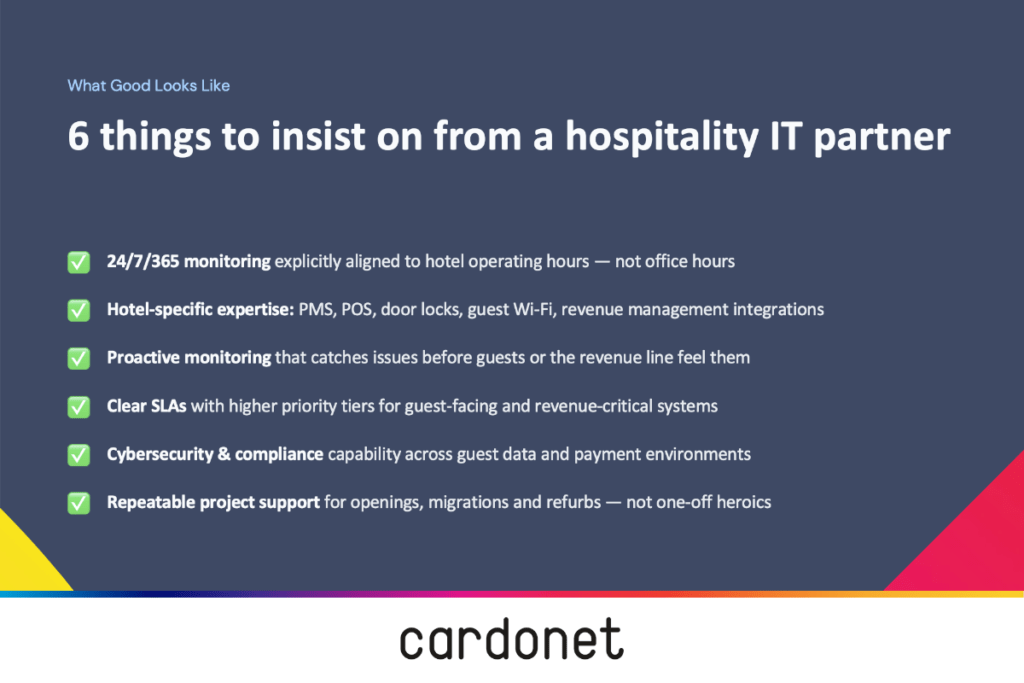
Why supportability is a design‑stage decision
For a hotel group, technology choices have two layers of cost and risk: licence and project capex, and the ongoing cost of running, supporting, and securing those systems. Feasibility models usually focus on the first and smooth over the second with a generic “IT” number that assumes a small internal team can cover everything.
At the design stage you are already deciding:
- How many PMS, POS, CRM, revenue management, and building systems you will run across the portfolio.
- How tightly they will be integrated and where failures can cascade.
- How mission‑critical guest Wi‑Fi and digital guest experience will be in each asset class.
- Where servers, network cores, and cabling will sit, and how accessible they are for support.
Each decision drives support requirements: monitoring, incident response times, out‑of‑hours coverage, and the depth of expertise you need on PMS, networks, cybersecurity, and vendor ecosystems.
If you define the technology stack without defining the IT support model, you are effectively trying to run a complex distributed system with no operating model.
Three hotel IT support models: in‑house, managed, and hybrid
For multi‑property hotel groups, there are three broad ways to deliver hotel IT support.
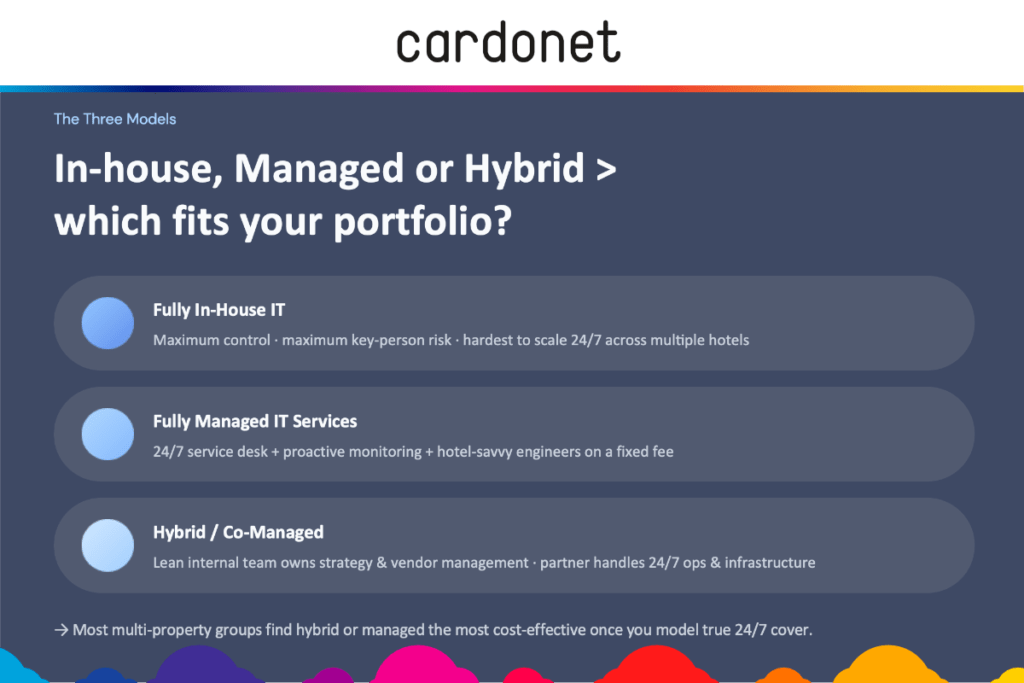
1. Fully in‑house IT support
Here you recruit and manage a team that owns everything: first‑line support, onsite response, project delivery, vendor management, and IT strategy. On paper that offers control and close alignment with your culture.
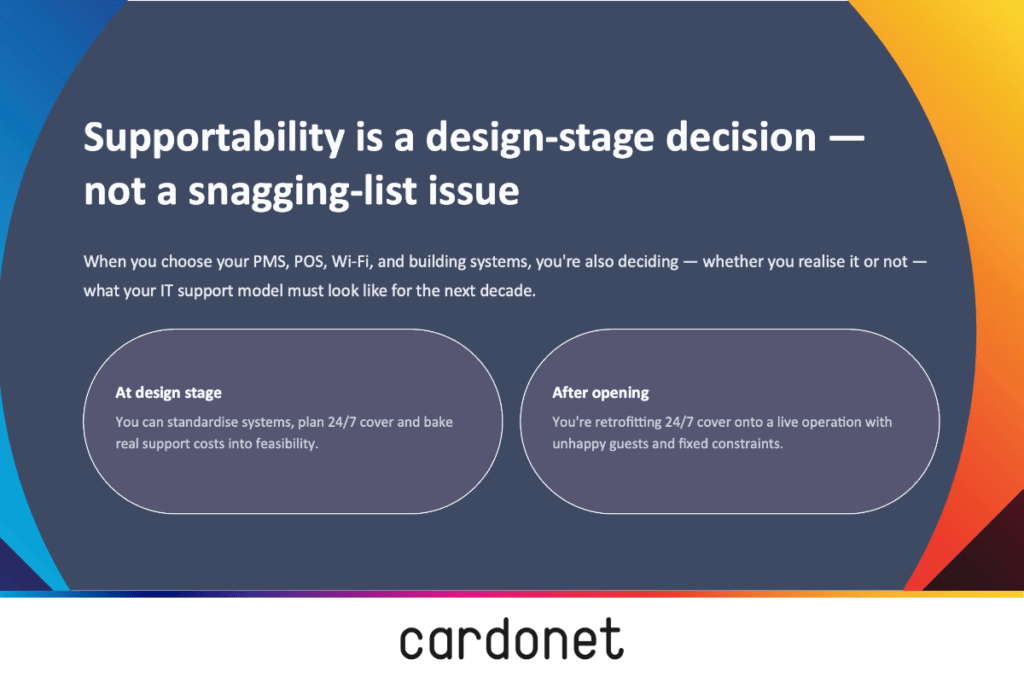
In practice, fully in‑house IT for hotels runs into predictable constraints:
- 24/7 coverage across multiple properties is hard to staff without over‑hiring or relying on “best efforts” on‑call cover.
- It is difficult to maintain deep expertise across hotel‑specific platforms like PMS, POS, locks, telephony, and guest Wi‑Fi as stacks evolve.
- Recruiting and retaining strong engineers with hospitality experience is competitive and expensive, particularly in major markets.
- Key‑person risk is high – if one or two people hold most of the system knowledge, their departure becomes an operational incident.
- Project spikes (openings, refurbishments, migrations) land on the same team that is already firefighting the usual day-to-day issues.
The usual result is a hard‑working but reactive team with limited capacity for proactive monitoring, root‑cause analysis, or strategic improvement.
2. Fully managed IT services (outsourced)
In a managed model you partner with a specialist managed IT services provider to deliver most of your IT support: 24/7 monitoring, service desk, onsite response, infrastructure management, and often cybersecurity. The right partner understands hotel operations, PMS and POS ecosystems, and the reality of running always‑on guest‑facing environments.
Key advantages include:
- Proactive IT support and 24/7 monitoring aligned to hotel operating hours, not office hours.
- A larger, multi‑disciplinary engineering team with deeper expertise in networks, cloud, cybersecurity, and hotel system integrations.
- Fixed‑fee or predictable pricing that makes IT support costs more transparent at portfolio level.
- Mature processes and SLAs for response and resolution, backed by scale and repeatable tooling.
- Access to project delivery capacity for openings, refurbishments, and migrations without building that capability entirely in‑house.
However, to get these benefits, you have to invest in selecting the partner, defining hotel‑specific SLAs, and treating them as a strategic extension of your team rather than a commodity “break/fix” supplier.
3. Hybrid / co‑managed hotel IT support
A hybrid model combines internal resource with hospitality managed IT services. Typically:
- A lean internal team focuses on vendor management, project oversight, and hotel‑specific processes.
- A managed service provider handles 24/7 service desk, monitoring, infrastructure management, and onsite support.
- Responsibilities are clearly split, with shared tooling and reporting so issues do not fall between the cracks.
For many groups this proves the most pragmatic “best of both”: you retain control over brand standards and strategic direction, while a specialist partner delivers day‑to‑day multi‑property IT support and technical depth.
Design‑stage vs post‑opening: what changes
Deciding your hotel IT support model at design stage gives you levers you simply do not have once the property is live. You can:
- Standardise systems and integrations across the portfolio so one support model covers many properties.
- Design networks, server rooms, and cabling with remote monitoring and support in mind.
- Bake realistic support costs into feasibility models rather than discovering them after the first high‑season outage.
If you wait until post‑opening, you are trying to retrofit 24/7 coverage, proactive monitoring, and security controls onto a live operation with fixed constraints and limited tolerance for disruption.
Decision lenses at the design stage
When you are still at feasibility, design, or early development, you have the most flexibility to choose both technology stack and hotel IT support model. At that point, three lenses matter most.
1. Portfolio and operating model
- How many properties do you operate now, and what does the 3–5‑year pipeline look like?
- How many brands and PMS platforms will you run, and how standardised do you intend to be?
- Are you mainly urban, resort, airport, or mixed, and what does that mean for onsite support?
The more complex and distributed your operation, the stronger the case for a managed or hybrid model.
2. Risk appetite and downtime tolerance
- What is the real business impact of PMS, POS, guest Wi‑Fi, or door lock downtime at peak occupancy?
- Do you have clear RTO/RPO targets for critical systems, and can an in‑house team realistically meet them across all properties?
- If your “go‑to” IT person in a flagship hotel left next month, how much operational risk would that create?
If your tolerance for failure is low, you need proactive IT support, documented processes, and 24/7 coverage embedded into your operating model.
3. Internal capability and focus
- Is your internal team set up to run a service desk and NOC, or are they better used on vendor management and commercial projects?
- Do you want your best people spending evenings troubleshooting guest Wi‑Fi, or shaping the next phase of your digital guest journey?
Hybrid hotel IT support models often free internal teams to concentrate on value‑adding work while the managed provider handles repeatable issues.
What “good” hotel IT support looks like in a managed or hybrid model
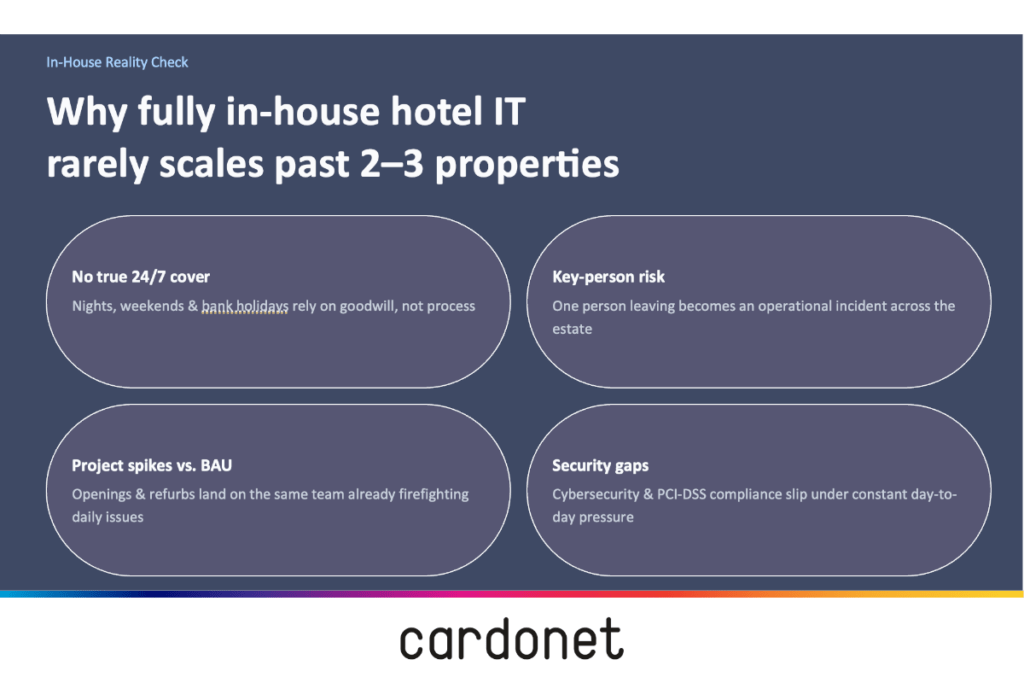
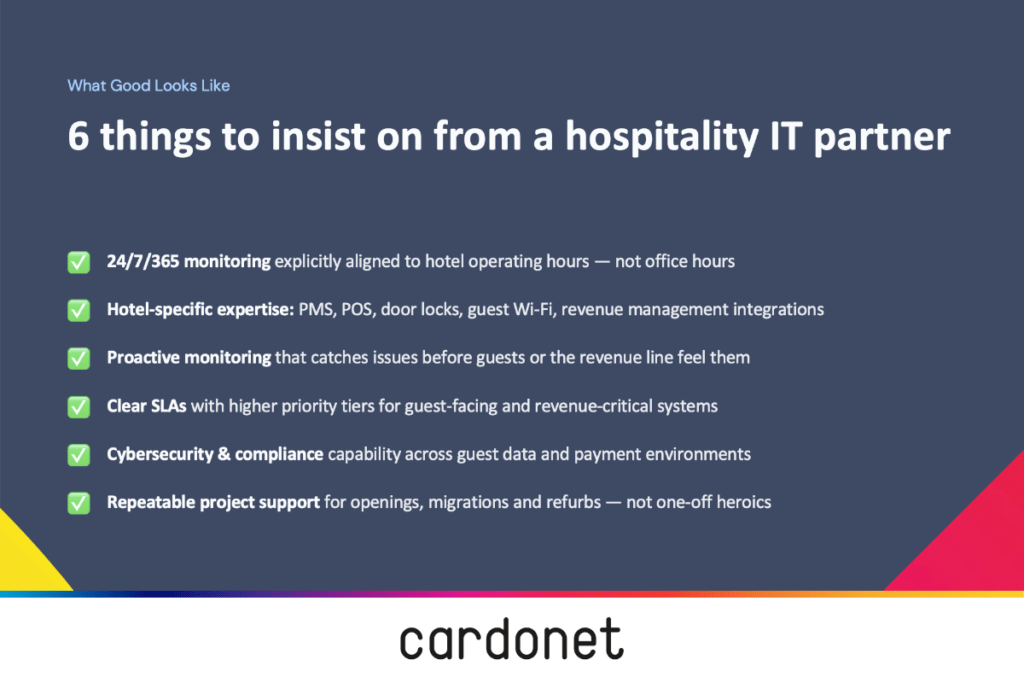
Once you decide fully in‑house is not the end state, the question becomes: what should you insist on from a hospitality managed IT services partner?
Look for:
- 24/7/365 monitoring and support explicitly aligned to hotel operating hours.
- Demonstrable experience with hotel‑specific systems: PMS, POS, locks, guest Wi‑Fi, revenue management.
- Proactive monitoring that catches issues before they hit guests or revenue.
- Clear SLAs for response and resolution, with higher priorities for guest‑facing and revenue‑critical systems.
- Cybersecurity and compliance expertise for guest data and payment environments.
- The ability to support hotel IT projects – openings, migrations, refurbishments – using a repeatable framework, not one‑off heroics.
How easy it would be to get local engineers who can be onsite quickly when remote options are exhausted are worth probing for.
A design‑stage checklist
To embed supportability into your design process, build these questions into early‑stage reviews with architects, brand IT, and your chosen partner.
Technology selection
- Does each shortlisted system come with clear support requirements and integration dependencies?
- How will incidents be detected, escalated, and resolved across PMS, POS, network, and building systems?
Infrastructure design
- Where will core network and server equipment live, and how will it be accessed safely for support?
- Is cabling and Wi‑Fi design aligned with the support model (remote diagnostics, segmentation, monitoring)?
Operating model
- Which tasks sit with internal teams, and which with your managed hotel IT support partner?
- How are responsibilities split between construction teams, brand IT, owners, and the support provider pre‑ and post‑opening?
Continuity and security
- What are your RTO/RPO targets for each critical system and how will they be met across the portfolio?
- How will PCI‑DSS and data privacy obligations be handled in your chosen support model?
Handled early, these questions turn “IT” from a generic cost line into a deliberately designed hotel IT support operating model.
Bringing it together: choose the model before the stack
It’s simple: do not let technology selection run ahead of your IT support thinking. Decide whether you are aiming for in‑house, managed, or hybrid hotel IT support before you sign PMS contracts, finalise network designs, or approve guest‑facing innovations.
Fully in‑house IT may work for a small, stable portfolio with modest digital ambitions, but most modern hotel groups run multi‑system, integrated, always‑on operations that are better served by a managed or hybrid model. Treat supportability as a core design criterion at feasibility stage and you protect guest experience, control lifetime IT costs, and give your teams a technology environment they can run – not just one that photographs well in the design presentation.


You must be logged in to post a comment.