
Cloud adoption has reached near-universal status among larger organisations: 94% of enterprises now use cloud services in some form, and 72% of all global workloads are now cloud-hosted. Smaller businesses are not far behind: the Flexera 2026 State of the Cloud report found that SMB workloads running in the public cloud jumped from 55% to 63% in a single year, a sign that cloud is no longer an enterprise-only conversation.
And yet success rates remain stubbornly mixed. Independent analysis shows that while cloud can unlock significant business value, many programmes leak value through missteps and inefficiencies. The pattern is familiar: promised savings, rushed timelines, unplanned complexity, and then a cloud bill that keeps climbing for reasons nobody can quite explain. UK-specific research also suggests that most businesses found their move to the cloud more costly than envisaged, with delays and hidden complexity common.
In our experience, cloud projects do not fail because the technology is difficult; they fail because the questions were too vague. If your goal is to “be in the cloud by Q4”, you are already over budget – you just have not seen the invoice yet.
Why rushed cloud moves backfire
Cloud migration projects tend to go wrong for mundane and unglamorous reasons such as unclear objectives, limited discovery, optimistic budgets, and a “lift and shift” mindset that treats the cloud as if it is just another data centre.
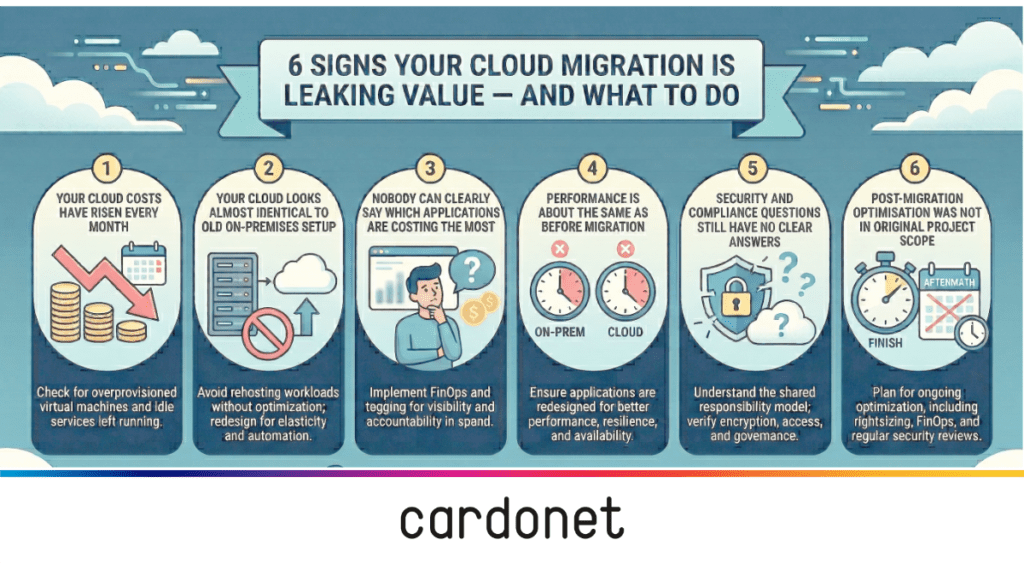
Cost control is the pain that lingers longest because a big chunk of the outlay is wasted through over-provisioned resources, idle environments and forgotten services. Waste compounds quickly when teams simply recreate on-premises architectures in the cloud without considering how to improve things. You’re on the cloud but nothing feels cheaper, faster, or simpler.
Human factors make this worse. People keep using systems the old way while the organisation pays for a new platform; speed of adoption does not automatically lead to well-managed adoption.
The cloud is not inherently expensive or risky unless migrations proceed without a structured framework linking technical decisions to business intent. If migration is treated as a series of isolated tasks rather than an end-to-end transformation, it becomes very difficult to control risk, cost and performance.
A practical cloud migration framework that works
A workable cloud migration framework links three phases: strategy, execution and post-migration optimisation, with feedback loops between them rather than a simple linear path.
Phase 1: Cloud Migration Strategy and Discovery.
Define why you are moving, what success looks like, and which applications are actually suitable for migration. This is where structured assessments, such as Cardonet’s formal Cloud Readiness Service, give you evidence rather than assumptions by reviewing application, integration, and operational requirements.
You can map applications to migration approaches using established patterns often described as the “6 Rs”: rehost, replatform, refactor, repurchase, retain, or retire.
Not every workload deserves the same amount of effort and forcing everything into a lift-and-shift model usually guarantees higher costs and limited benefit. A legacy reporting tool that nobody uses should be retired not retained.
Migration priorities must be linked to business drivers, for example reducing data centre exposure, enabling remote work, supporting new digital services, or meeting regulatory requirements. If you can’t explain how migrating a system will shift the dial, it should not be a priority.
Phase 2: Cloud Migration Detailed Planning and Design.
Translate strategy into concrete architecture, timelines and responsibilities by defining landing zones, identity and access models, networking, security controls and backup strategies before workloads move, rather than treating these as follow-up tasks. Build a realistic migration roadmap that sequences workloads and plans for testing and rollback. Identify where you will use automation tools or Infrastructure as Code to maintain consistency and repeatability.
Phase 3: Cloud Migration Execution.
This is where well-planned frameworks prove their value because you are following a defined playbook rather than improvising under pressure. Phasing migration, starting with lower-risk or non-critical workloads, lets you test patterns, refine automation, and build confidence before tackling complex or business-critical systems.
You earn the right to move critical systems by showing that the approach works on less risky ones.
Operational continuity must be a hard constraint. This means planning maintenance windows, fallback paths, data synchronisation mechanisms, and clear communication so business users know what to expect and how to raise issues during cutover.
It also means defining measurable success criteria for each wave of migration instead of treating “in the cloud” as the only goal that matters.
Skills and ownership are equally important during execution. UK research into cloud migrations highlights skills shortages and unforeseen complexity as key reasons why projects overrun or underperform, especially where internal teams are expected to learn new platforms while maintaining existing services.
Clarifying responsibilities between internal IT, cloud providers and partners and ensuring that support processes reflect the new environment will help avoid gaps where incidents fall between teams and remain unresolved.
One practical rule: if everyone is responsible for a migrated application, nobody is.
Post-migration optimisation: reclaiming value from the cloud
One of the most persistent myths about cloud migration is that the work ends once the last workload has moved. In reality, post-migration optimisation is where a significant share of the financial and operational value is either captured or lost, depending on how actively you manage the new environment. Migrations can deliver meaningful cost savings when well-executed, but poor configuration and limited governance can also lead to considerable wastage.
Effective post-migration optimisation covers three main areas:
- Cost – measure and rightsize resources based on actual workload usage, apply scheduling to non-production environments, and make informed use of reserved instances or savings plans where workloads are stable.
- Performance – monitor latency, throughput and error rates to identify where refactoring or architecture changes could improve user experience or resilience, instead of assuming that the initial design is final.
- Security – use cloud-native tools and governance models to manage identities, detect misconfigurations and ensure that the shared responsibility model is understood and applied across teams.
Formalise optimisation work by bringing finance, IT and operators together around shared metrics for cloud value. Rather than treating the cloud bill as a static line item, treat it as a controllable outcome linked to design choices, usage patterns and business priorities. This means regular reviews where teams explain not just spending, but also returns.
For many organisations, that optimisation phase is best supported by ongoing proactive IT management, such as a dedicated global helpdesk and cloud management service, which monitors and tunes the environment over time rather than leaving it to drift.
What good cloud migration looks like in practice
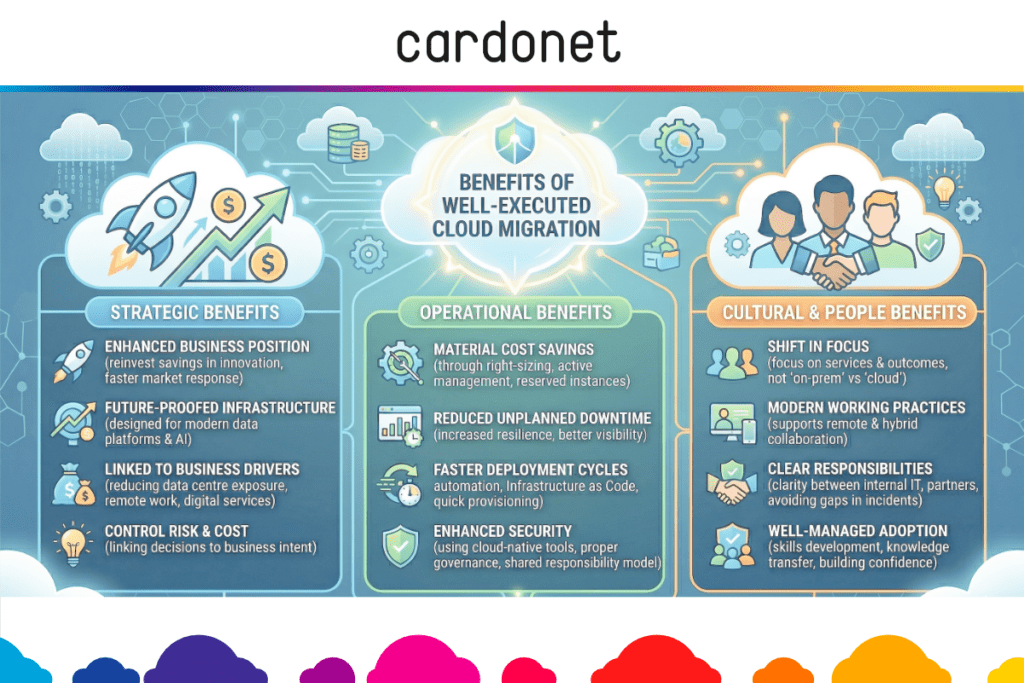
When organisations follow a structured framework, “good” cloud migration becomes visible in both numbers and day-to-day operations. Independent reports suggest that well-planned cloud adoption can deliver material cost savings and operational benefits, particularly when combined with rationalisation of legacy licensing and support contracts and modernisation of critical applications.
Operationally, a successful migration shows up in reduced unplanned downtime, faster deployment cycles and clearer visibility of infrastructure and application health.
Teams can provision environments quickly, roll back changes safely, and rely on monitoring and alerting that reflects the actual architecture rather than a patchwork of legacy tools. Aim for people no longer talking about “on-prem” versus “cloud” but rather about services and outcomes.
Strategically, the organisation becomes better positioned to adopt new capabilities such as modern collaboration tools, data platforms, and AI services, because the infrastructure has been designed with future change in mind rather than frozen in the past (where it has simply been lifted-and-shifted).
Why this matters
Cloud migration is no longer a side project; it directly affects revenue, cost base, resilience and competitive positioning. If migrations underperform, organisations end up paying for both legacy systems and cloud platforms while struggling with performance and downtime.
Getting it right does not just deliver technical success; it creates the ability to reinvest savings into innovation, respond faster to market changes, and support modern working practices such as hybrid and remote collaboration.
Protecting your business: Cloud Migration next steps
For organisations still in the planning stage, a cloud readiness assessment is often the most effective starting point. It gives you a structured view of your current estate, highlights which applications are suitable for migration, and identifies integration and compliance considerations before you commit to timelines or budgets.
If you have already migrated but are concerned about rising costs or mixed performance, a focused post-migration review can be equally valuable. This will allow you to benchmark your current environment against best practice, identify quick wins in cost optimisation or architecture changes, and decide where to refactor or modernise.
In both cases, working with a partner who understands cloud platforms and on-premises realities can help you avoid repeating common mistakes and focus on practical, incremental improvements rather than disruptive rework.
FAQs: Cloud migration framework
What is a cloud migration framework?
A cloud migration framework is a structured approach that guides organisations through planning, executing and optimising the move of applications, data and workloads to cloud platforms. It typically covers discovery, business case definition, migration strategy, architecture design, execution planning and post-migration optimisation.
Why do so many cloud migrations fail or underperform?
Many cloud migrations fall short of expectations because of inadequate planning, skills gaps, underestimated complexity and unclear success criteria. Common issues include cost overruns, performance problems, security misconfigurations and weak alignment between business objectives and migration priorities.
How can we control cloud costs after migration?
Cloud costs are best controlled through active, ongoing management — rightsizing resources, shutting down idle environments, using appropriate pricing models such as reserved instances, and adopting FinOps practices that bring finance and IT together to monitor usage, allocate costs and continually optimise spending against business value.
Do we need to refactor all applications to get value from the cloud?
Not every application needs to be refactored immediately. Most frameworks use patterns such as the “6 Rs” to match workloads to appropriate migration strategies, from simple rehosting to full modernisation. The right approach depends on business importance, technical constraints and expected lifespan — not a single rule applied to every system.
What should we look for in a cloud migration partner?
A good partner demonstrates experience with similar migrations, understands your sector, uses clear methodologies and commits to knowledge transfer rather than long-term lock-in. Ideally they should support readiness assessment, migration execution and post-migration optimisation, aligning their work to measurable business outcomes rather than purely technical milestones.


You must be logged in to post a comment.