
Opening: Can Your Tech Survive 100% Turnover
Can your restaurant technology still run a smooth service when half the team joined in the last twelve months. If the answer to that question is “no” then you haven’t designed your restaurant IT support around beginners.
This is a mistake. The latest State of Restaurant Workforce 2024 research from Black Box Intelligence shows hourly turnover in some restaurant segments has recently been in the 90–135% range, far higher than most industries.
Their analysis also puts the “hard cost” of replacing an hourly restaurant worker at just over $2,300, before you factor in softer losses from slower service and mistakes. If your restaurant IT support model only works when experienced staff are on shift, you are baking fragility into every peak service.
High Turnover as a Technology Problem
High staff turnover is accepted as a structural feature of hospitality, meaning that, in practice, a large share of your front- and back-of-house teams is always somewhere on the learning curve, trying to master systems while keeping up with a busy service.
Every new hire has to learn how to place and modify orders, send items to the kitchen, and take payment without creating chaos. When those journeys are fragile, inconsistent between locations, or reliant on a handful of “power users” who know the unofficial workarounds, high churn exposes your every weakness, often on your busiest nights.
Where Systems Break Under Pressure
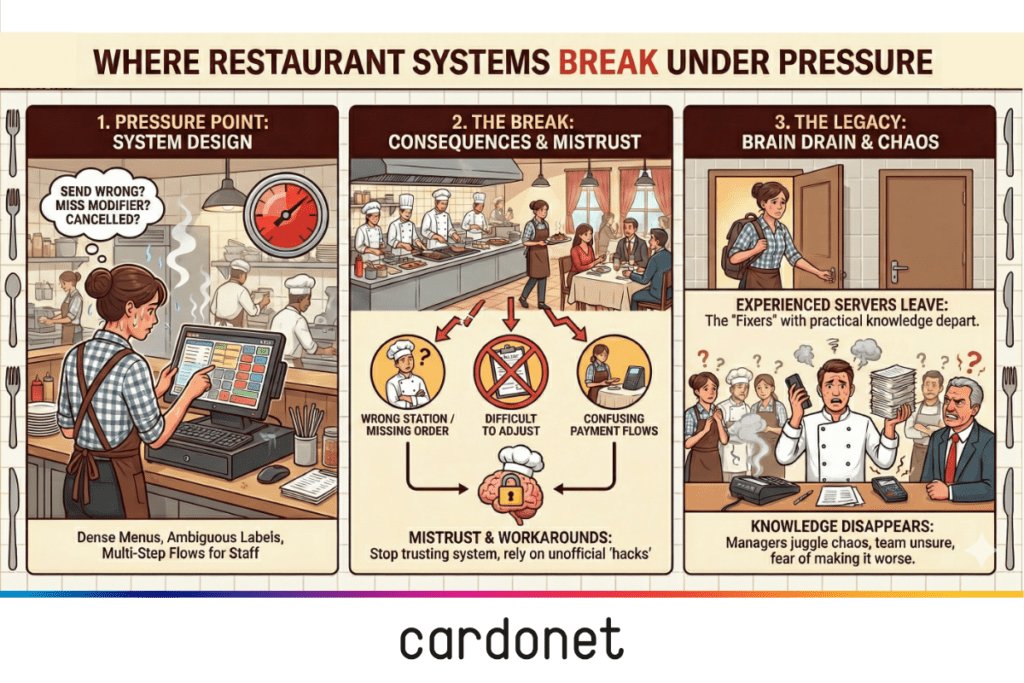
New servers face dense menus, ambiguous button labels, and multi-step flows for tasks that should be straightforward. Under pressure, they send the wrong items, miss modifiers, and cancel things they shouldn’t.
As a result:
- Orders go to the wrong prep station or don’t appear at all
- Orders are difficult to adjust when guests change their minds
- Payment flows confuse staff when bills are split
After a few bad experiences, people stop trusting parts of the system and rely on whatever workaround the last person showed them, even if it was never part of the design.
In many restaurants, practical knowledge lives with a few experienced staff who can untangle problems on the fly. They know how to recover a closed check, reverse a misapplied discount, or restart a frozen terminal without losing orders.
When those people leave, the technology doesn’t change, but the confidence to fix issues disappears and managers are left juggling guest complaints, manual workarounds, and calls to support while the rest of the team watches, unsure whether pressing the wrong button will make things worse.
Designing for People Who Are New Every Night
If we accept that high turnover is here to stay, the design target has to change. Instead of assuming most of the team is experienced, IT support and systems must be designed for a world where beginners use them on every shift. Don’t strip out capability, just make sure that the journeys that matter are clear, predictable, and forgiving.
For most restaurants, those journeys centre on opening and managing checks, entering and modifying orders, sending items to the right preparation point, and taking payment in the way the guest expects.
When you look at your screens through that lens, you quickly see where complexity has accumulated, often through sensible decisions made at different times that now add up to a confusing experience for anyone new.
One useful test is simple: could someone with a day’s training follow the on-screen path for each of those tasks without needing a senior colleague to intervene? If the honest answer is “not really,” you are looking at a design problem more than a people problem.
Reducing Clutter Without Losing Control
Fragility often comes from the gap between everything your systems can do and what they need to do during a busy service.
Servers do not need configuration menus, complex discount rules, or detailed financial reports on the same screens they use to send starters to the kitchen. When you tie permissions more carefully to roles, most people see a cleaner, simpler interface that reflects their responsibilities, while managers still have access to the deeper controls they need.
Fixing this lowers the mental load on new staff and supports security and compliance, because sensitive functions sit behind the extra checks you expect for those decisions (rather than appearing as tempting buttons during a rush).
Sharing the Training Load with Your Systems
Most restaurants do not have the luxury of long, formal training programmes every time someone joins.
New hires usually learn through a mix of short briefings, shadowing, and trial by fire. The Hospitality Training 360 report, based on feedback from over 120 restaurant training leaders, notes that training time for restaurant staff is under pressure and that operators are trying to do more with fewer formal hours.
That reality makes system prompts, confirmations, and clear error messages more important than ever.
There is a human side to this as well.
People are more likely to stay when expectations are clear, tools work as expected, and support is visible. Technology that helps them succeed instead of catching them out sends a strong signal about what kind of operation you run.
In a tight labour market, that signal can matter as much as pay when people decide whether to stay or move on.
Why Standardisation Matters Beyond Cost
For multi-site restaurant IT, inconsistency is an invisible tax on every transfer and every cover shift. If each location has its own menu layout, its own shortcuts, and its own quirks, even experienced staff feel like new starters when they move between sites. They have to learn new local workarounds, and good practices fail to spread because there is no common template to update.
Standardising core workflows, layouts, and procedures across locations does more than save configuration time. It creates a shared language for training, makes it easier to flex staff between sites, and allows a partner like Cardonet’s restaurant IT solutions team to support your estate with a single mental model rather than a different puzzle at every venue.
Seeing Your Operation Clearly
None of this requires a new platform on day one; it starts with seeing your own operation clearly.
Take a couple of busy services and watch how people actually use your systems, focusing on the moments that matter most: before service when checks and printers are set up, during the rush when orders and payments stack up, and at close when the day has to reconcile cleanly.
You will find points where staff hesitate or ask for help, steps nobody can explain but everyone follows, and flows where the intended process has been replaced by a workaround that only exists in people’s heads.
This will show you exactly where design and reality are out of kilter, and, usually, a small set of changes will remove a disproportionate amount of friction.
Making Changes That Actually Stick
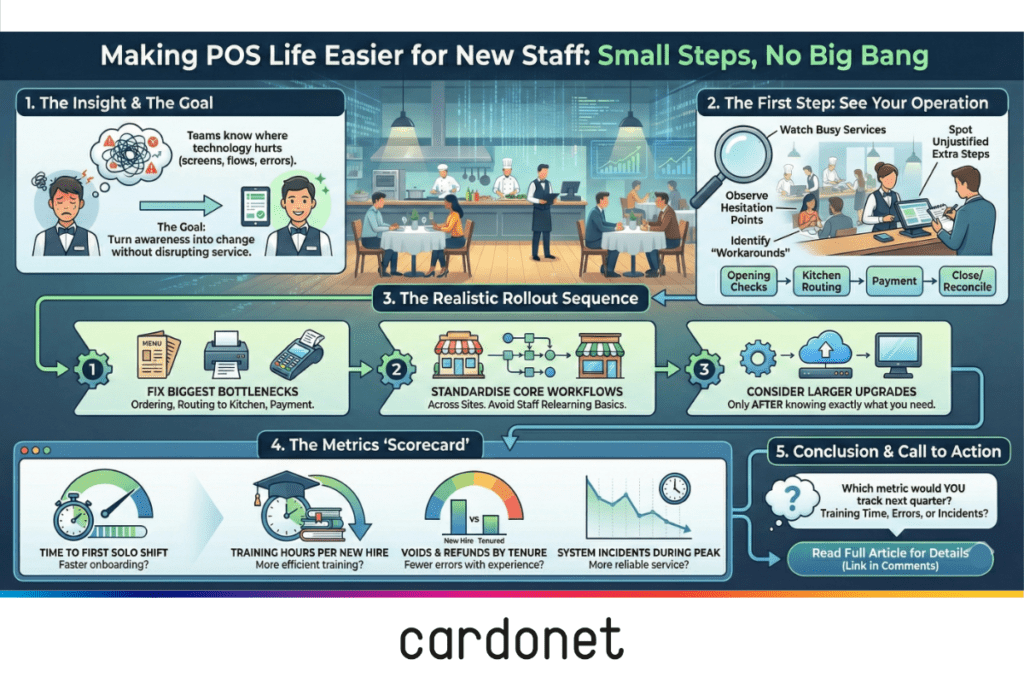
Once you know where the friction is, the challenge is changing it without disrupting service. Move in small, deliberate steps instead of trying to redesign everything at once.
- Simplify menu categories
- Remove buttons nobody can remember using
- Adjust prompts around the actions that cause the most trouble
A sensible sequence for most operators is:
- Fix the most painful service bottlenecks first, such as ordering, kitchen routing, and payment
- Standardise one or two core workflows across all locations so training becomes repeatable
- Only then consider larger system changes or upgrades once the basics are stable
If this is combined with a basic training path for every new hire, rookies reach confidence faster and managers recover time that used to disappear into repeatedly solving the same problems.
Why All This Matters
Black Box Intelligence’s State of Restaurant Workforce 2024 analysis highlights that restaurants in the best quartile for turnover see several percentage points higher same‑store traffic growth than those in the worst quartile.
The same research puts the average “hard cost” of replacing hourly staff at more than $2,000 per person, not counting softer impacts on guests and teams. Other work on training and labour trends, such as the Hospitality Training 360 report, underlines that training time is tight and operators need to get more value from every hour they spend on onboarding.
Restaurant IT support designed for high turnover teams protects revenue at peak times, reduces hidden training and incident costs, and gives operators more headroom to focus on growth rather than firefighting.
If you want to explore how infrastructure, monitoring, and support aligned to real service patterns can work in your estate, Cardonet’s IT support services set out practical options for restaurants and hospitality businesses.
FAQs: Restaurant IT Support for High Turnover Teams
How does high staff turnover change the IT support you need?
High turnover keeps more of your team in the early stages of the learning curve, which raises the risk of mistakes and inconsistent use of systems. You need IT support that is available during real service periods, understands restaurant workflows, and can help staff recover quickly from issues without long delays. Standardised setups and clear escalation paths make it easier for a support partner to resolve incidents on first contact.
What should I prioritise if I cannot change everything at once?
Start with the journeys that most directly affect guests: taking orders, sending them to the kitchen, and taking payment smoothly. Simplify those flows, tighten permissions to reduce accidental changes, and make sure staff on shift know exactly who to call when something goes wrong. Those steps usually deliver visible benefits without major capital spend.
How do I justify investment in more resilient systems to owners or investors?
Link improvements to measurable outcomes rather than abstract benefits. Shorter training times, fewer voids and refunds, reduced downtime during service, and lower staff turnover all translate into money saved or revenue protected. The Black Box Intelligence workforce research mentioned earlier provides useful benchmarks you can compare to your own figures to build a clearer business case.
Does this approach only apply to large multi site groups?
It helps large groups, but it is just as relevant to independents and small chains. Smaller operators often feel the impact of turnover and fragile systems more acutely because there is less slack in the team. The same principles of clear workflows, role-based access, consistent training, and responsive support apply whether you run one dining room or twenty, and smaller estates can often standardise more quickly.
How can Cardonet help restaurants dealing with high turnover?
Cardonet works with restaurants to assess their current infrastructure and support model, identify where staff turnover is putting technology resilience at risk, and design practical changes. That can include network and POS architecture, monitoring, support that matches service hours, and projects to standardise and simplify systems across sites, all delivered through our restaurant IT solutions.


You must be logged in to post a comment.