
Why does checking in a guest take two minutes at your flagship London property but ten minutes in Machester?
It’s easy to blame staff and tempting to think that training will simply fix the issue, but the real problem is likely the invisible patchwork of different systems, legacy contracts, and local workarounds that have accumulated over years of expansion.
Decentralized IT is not just an operational headache; it is bleeding revenue and damaging your brand.
When every property runs its own show, you can pay 30-40% more in duplicate software licenses and support contracts – a figure consistent with Gartner’s finding that vendor consolidation can cut support costs by up to 30%. You expose your group to security risks because your weakest property defines your total vulnerability. Worst of all, you cannot see your own data – leaving you guessing about guest preferences and performance across the group.
It is time to stop treating each hotel as an island and start running your group as a unified platform.
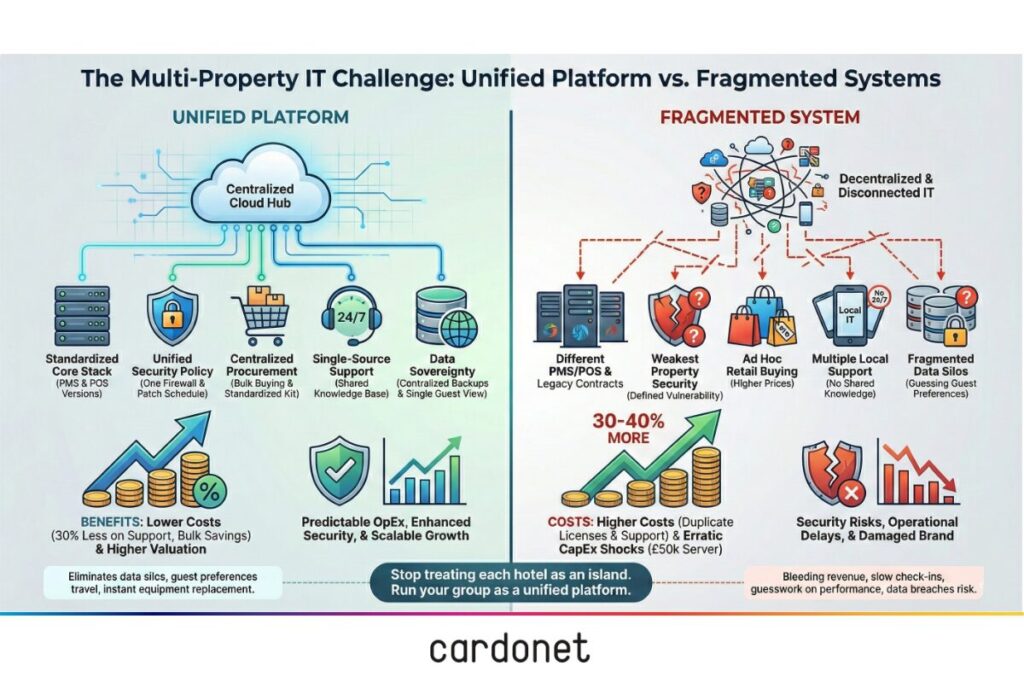
The 5 Pillars of Control
You cannot manage ten hotels effectively if you have ten different ways of doing IT. You need a centralized operational framework that dictates the rules while allowing for execution on the ground.
At Cardonet, we build this around five non-negotiable pillars:
- Standardized Core Stack: Every property must use the same Property Management System (PMS) and Point of Sale (POS) versions. This integration allows for a single view of the guest and eliminates the data silos that PwC identifies as a major barrier to growth.
- Unified Security Policy: Security cannot be a local decision. You need one firewall standard, one antivirus policy, and one patch management schedule pushed from the centre.
- Centralized Procurement: Local GMs should not be buying hardware ad hoc and at retail prices. Bulk buying standardized kit saves money and makes replacing broken equipment instant.
- Single-Source Support: Your night porter in Edinburgh should call the same 24/7 service desk as your receptionist in Bristol. This builds a shared knowledge base where a fix found for one hotel can immediately be applied to all.
- Data Sovereignty: Guest data belongs to the group, not the property. Centralized backups and storage ensure that if a hotel burns down, your business data survives.
In practice, this means when a critical security update is released, we push it to all hotels in the group instantly. We don’t call multiple local IT managers and hope they get around to it.
The Failure Mode: Local Nuance
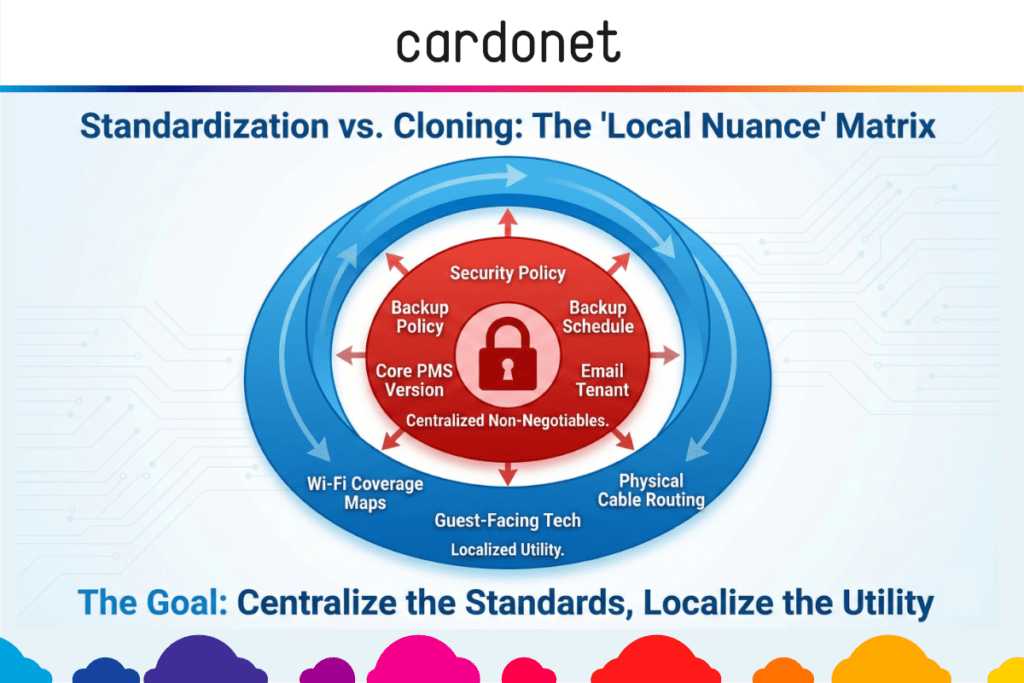
The biggest mistake I see Head Offices make is confusing “standardization” with “cloning.”
If you try to force a city-centre business hotel’s IT policy onto a luxury countryside resort, you will fail. A resort needs high-density Wi-Fi in the gardens and spa; a business hotel needs secure, high-speed wired connections in the conference rooms.
The failure mode is rigidity.
When you lock down permissions so tightly that a General Manager cannot reboot a frozen router without submitting a ticket to a support desk 200 miles away, you kill operations. The goal is to centralize the standards (security, backup, core software) but localize the utility (Wi-Fi coverage maps, specific guest-facing technology).
Your staff need the power to solve guest problems immediately. If your centralized policy stops them from doing that, the policy is wrong.
Moving from Patchwork to Platform
You cannot fix a messy estate overnight. Most hotel groups we audit are trapped in a web of legacy contracts ending at different times.
Don’t try to boil the ocean.
Start with an audit of what you actually have – most Ops Directors are shocked to find they are paying for software licenses for staff who left two years ago.
Once you know the baseline, move in three phases:
- Secure the Perimeter: Deploy a unified security and backup layer first. This stops the bleeding and protects you from the average £3.9 million cost of a data breach cited in the 2025 IBM Cost of a Data Breach Report.
- Standardize the Core: Migrate all sites to the same PMS and email tenant. This is the hardest part, but it delivers the biggest productivity wins.
- Migrate the Satellites: Bring the outlier properties into line as their legacy contracts expire.
You will face resistance on the cost. But remember: this is a shift from erratic Capital Expenditure (CapEx) shocks – like spending £50k because a server died – to a predictable Operational Expenditure (OpEx) model. You pay a fixed monthly fee for a working system, not a variable fee for fixing broken ones.
The “Hotel in a Box” Standard
When you buy a new property, you shouldn’t be reinventing the wheel. You should have a “Hotel in a Box” IT standard ready to go.
Here is a checklist you could use to onboard a new site into a group:
| Category | Standard Requirement |
| Connectivity | Primary & Backup internet lines (diverse routes) |
| Network | Standardized VLANs for Guest, Staff, and VoIP traffic |
| Workstations | Locked-down image with pre-installed PMS & Office apps |
| Security | Managed Endpoint Detection & Response (EDR) agents deployed |
| Wi-Fi | Access Points mapped to group SSID standards (one login everywhere) |
| Power | UPS battery backup on all core comms cabinets |
| Support | “Help” icon on every desktop linked to the Group Service Desk |
Why This Matters
This isn’t just about making IT easier. It’s about business value.
Valuation: If you plan to sell or refinance, a standardized hotel group is worth more than a loose collection of assets. Investors pay for a scalable platform, not a headache.
Guest Loyalty: A guest expects their preferences to travel with them. If they stayed in your London hotel, your Leeds hotel should know they prefer a quiet room. You can’t do that with fragmented databases.
Risk Management: With the hospitality sector facing severe labour shortages, UKHospitality reports that technology reliance is increasing to bridge the gap. You cannot afford downtime when you are already understaffed.
Next Steps for Hotel Operations Directors
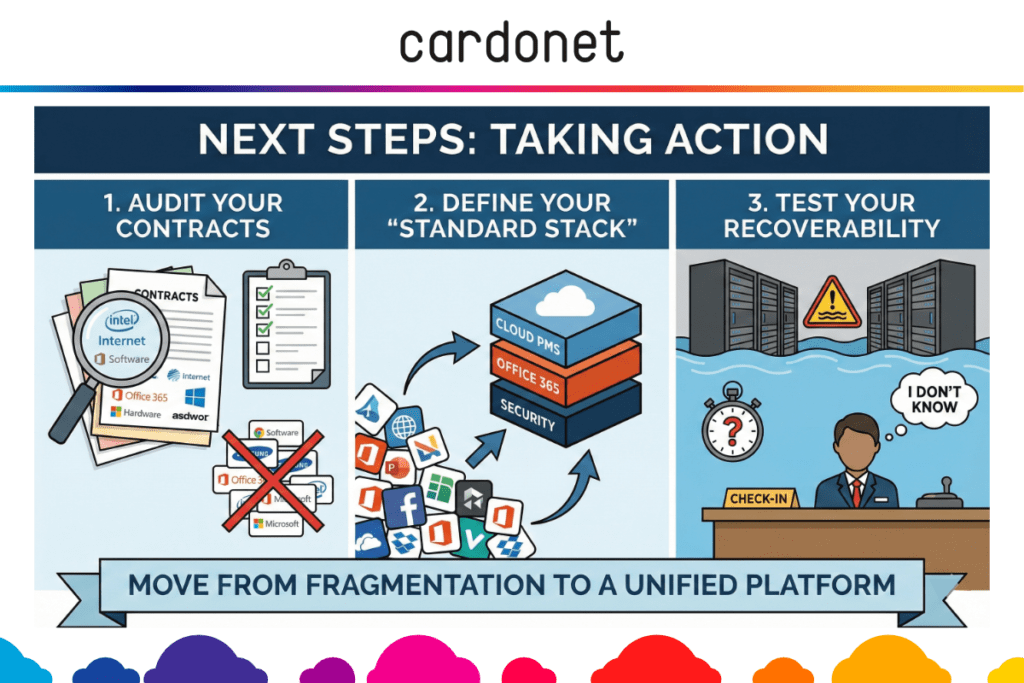
If you suspect your current setup is holding you back, take these three actions:
- Audit Your Contracts: List every IT supplier for every property. You will likely find you are paying three different companies for the same service.
- Define Your “Standard Stack”: Decide what the non-negotiable technology is for your group (e.g., “We are a Cloud PMS and Office 365 house”).
- Test Your Recoverability: Pick a property and ask, “If this server room floods today, how long until we can check in guests?” If the answer is “I don’t know,” you have a problem.
Book a Multi-Site Infrastructure Audit to see exactly where your inefficiencies are hiding, and let us show you how Cardonet’s hospitality-focused support turns IT from a daily frustration into the silent, reliable backbone your group deserves.
FAQs: Hotel IT Centralization
1. Will centralizing IT kill my local General Manager’s autonomy?
No. It removes the burden of managing servers and contracts from their plate, allowing them to focus entirely on guest experience and operations. They keep control of their budget; we just ensure they get better value for it.
2. Is a cloud PMS reliable enough for a busy hotel?
Yes, modern cloud PMS platforms are far more reliable than a dusty server in your basement. With proper redundant internet lines (4G/5G backup), your uptime will increase, not decrease.
3. How do we handle legacy contracts that have years left to run?
We manage them for you. We become the single point of contact, dealing with the third-party vendor until the contract expires, at which point we migrate that service to the group standard.
4. Can’t we just use a local IT shop for each hotel to save money?
You might save £10 an hour on the rate, but you lose thousands in inefficiency. A local shop cannot see the group-wide trends, won’t adhere to your corporate security standards, and cannot offer 24/7 specialist hospitality support.
5. What happens if the central connection goes down?
We design for failure. Critical systems like door locks and local POS have “offline modes” that keep working. We also install backup internet lines that kick in automatically, so your staff never even notice the main line dropped.


You must be logged in to post a comment.