
Is unified communications mainly a technology decision? Only on the surface. In practice it’s a delivery decision: how your organisation turns a fast conversation into an owned action, and how quickly someone else can pick up the thread when priorities shift.
Hybrid working is now normalised in many organisations. In the CIPD’s 2025 report, 74% of organisations said the majority of employees work in a hybrid way. Flexible and hybrid working practices in 2025 (CIPD) This matters because informal “corridor fixes” don’t scale across locations, so the communications layer needs to support clearer ownership, traceability, and handover.
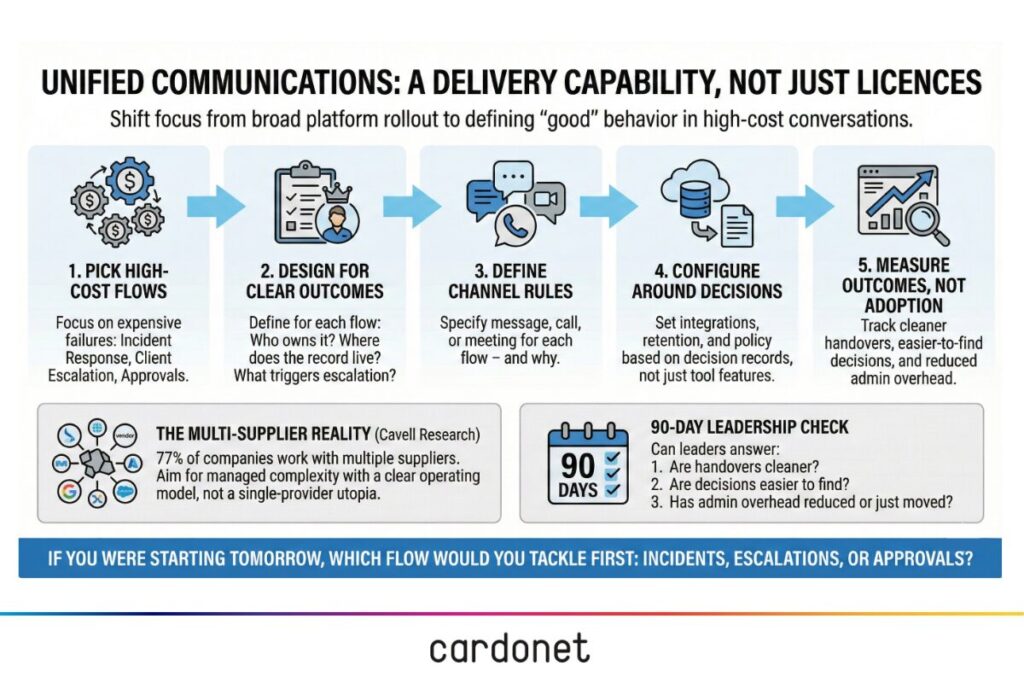
A useful reality check for UC architecture is supplier complexity: Cavell UC Market Evolution Report 2025 reports that 77% of companies work with multiple suppliers. So the goal is not “one platform to rule them all”, but a working model that reduces duplication and ambiguity even when the estate stays mixed.
The practical framework
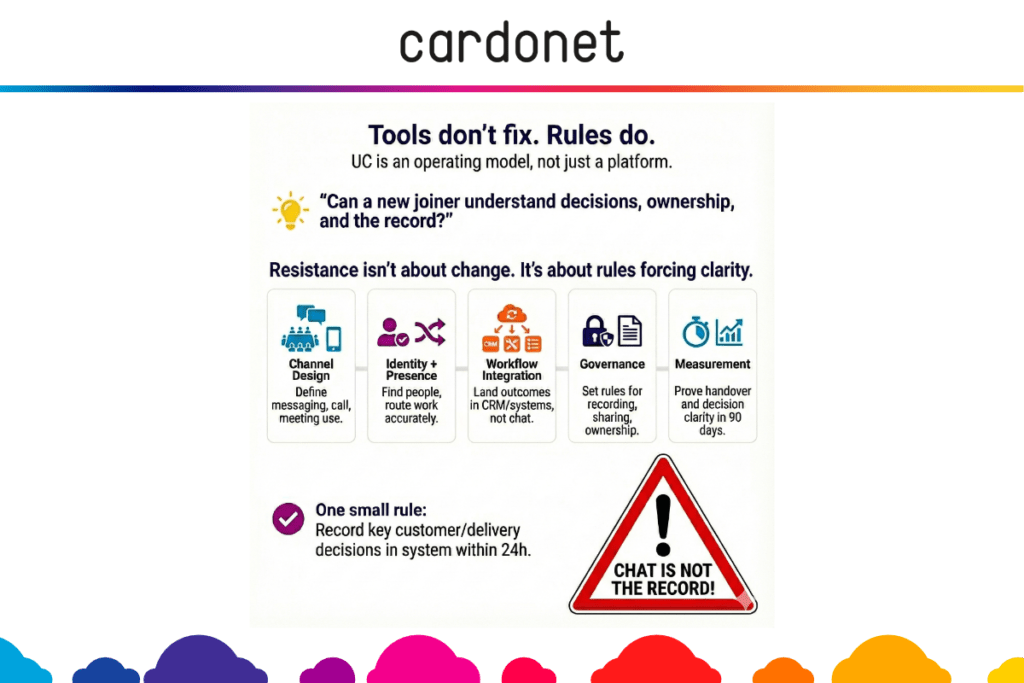
The most reliable way to evaluate unified communications is to start with five elements: channel design, identity and presence, workflow integration, governance, and measurement. Get these right and vendor selection becomes a fit exercise rather than an argument.
Channel design
UC only helps when people know what each channel is for. Otherwise, you just move the same confusion into a new interface.
A simple cross-jurisdiction standard that works is to define three modes and keep them stable:
- Messaging for short coordination and status.
- Calls for ambiguity and fast clarification.
- Meetings for decisions with multiple owners.
Approvals that touch client commitments usually need a recorded decision and a named owner, not a long message thread while retail or field operations teams can handle most updates in messaging, but stock discrepancies and escalations should jump to a call with a logged outcome.
Identity and presence
Presence is valuable when it saves wasted attempts. Teams can route work faster when availability is visible and consistent across devices and locations.
Identity is the hidden dependency. If people have multiple profiles, inconsistent contact records, or different directories depending on device or network, the organisation ends up with “unified” tools but fractured trust.
Workflow integration
UC becomes operational when outcomes land in the systems where work is tracked: CRM, service desk, project tools, and knowledge bases. This is the difference between “we discussed it” and “delivery now reflects it”.
Scope changes agreed in a meeting must land in the matter record or project plan the same day and incident escalation discussed on a bridge call must update the service desk ticket with owner, next step, and time stamp.
Governance
This is where reputations are protected. UC increasingly includes recording, transcription, file sharing, and external collaboration, which means the communications layer is also a data-handling layer.
The governance question is not “what does the platform allow?” but “what does the organisation permit, and how is that controlled?”. The ICO’s lawful basis guidance under UK GDPR also notes it is under review following the Data (Use and Access) Act coming into law on 19 June 2025, which is a reminder that governance needs owners and a review cycle, not a one-off checkbox. Lawful basis (ICO)
US note (pattern): if teams rely on recording/transcription, governance should still answer the same operational questions: purpose, access, retention, and how the record is used in disputes or audits.
Measurement
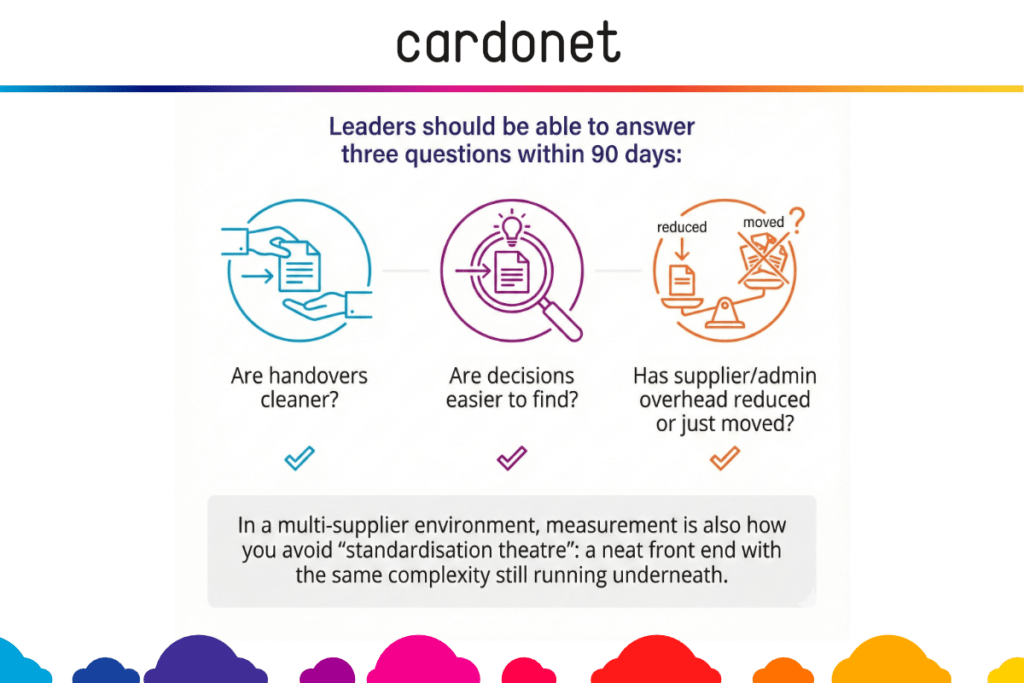
Adoption is necessary but insufficient on its own. Leaders should be able to answer three questions within 90 days:
- Are handovers cleaner?
- Are decisions easier to find?
- Has supplier/admin overhead reduced or just moved?
In a multi-supplier environment, measurement is also how you avoid “standardisation theatre”: a neat front end with the same complexity still running underneath.
How it breaks
UC fails quietly when the organisation never defines the rules of the road. People keep deciding things in disparate places, and the next person spends time reconstructing context instead of moving work forward.
It also fails when simplification is treated as purely a procurement outcome. Many organisations keep multiple providers for resilience or specialist needs, but without integration standards and clear support boundaries that choice becomes hidden cost.
Implementation reality
The most reliable implementation path is to start with the few communication flows that drive cost, risk, or client confidence. This prevents feature rollouts that look impressive and change little.
A practical sequence:
- Choose three high-impact flows (incident response, client escalation, approvals are common).
- Define channel rules and escalation triggers for each flow.
- Decide where outcomes must be recorded.
- Configure integrations, retention, and policies around those decisions.
This aligns with best practice in the Communications Technology pillar: business-led, change-aware delivery, grounded in real operating constraints.
What good looks like
When UC is working, the organisation stops depending on memory. Decisions are findable, ownership is explicit, and handover quality improves because the record is written where the business expects it.
Copy-paste artefacts that hold up across organisations:
- Decision capture rule (policy snippet): “Any decision that changes a customer commitment, delivery date, cost, or risk rating must be recorded in the system of record within 24 hours. Chat is not the record.”
- Escalation trigger (operating standard): “If a message thread runs for 10 minutes without a clear owner and next step, escalate to a call. If a call produces a decision, log it immediately.”
- Integration requirement (selection criterion): “Where communications touch delivery, outcomes must write back to CRM/service desk with owner, timestamp, and summary.”
UC maturity rubric
Use this to score your current environment or a proposed change without debating features.
Level 1 (tool-led): Channels exist, but outcomes are inconsistent and context is often lost.
Level 2 (workflow-led): Channel rules and escalation triggers are defined for key flows, and outcomes usually land in systems of record.
Level 3 (operating-led): Governance is explicit, integrations are deliberate, and measurement proves improved handovers and decision traceability.
Red flags to watch:
- Recording/transcription enabled without a clear purpose, retention, and access model.
- “Standardising” the interface while keeping fragmented support and ownership underneath.
- Measuring licence use instead of operational outcomes.
Why this matters
Hybrid working and supplier complexity mean communications design is now part of execution capability. If leaders don’t define the rules, teams will, and the organisation will pay for the inconsistency in delay, rework, and avoidable risk.
The strongest UC programmes aren’t the ones with the most features. They are the ones where leaders can point to a small set of operating standards and show that delivery improved because of them.
Protecting your business: next steps
- Run a “conversation-to-record” audit on three flows: where do decisions occur, and where do they get recorded today?
- Set a minimum UC operating standard (channel rules, escalation triggers, decision capture, governance owners).
- Book a UC effectiveness review focused on workflow outcomes and integration requirements, not feature demos.
FAQs: Unified communications
What counts as unified communications?
Unified communications brings messaging, meetings, voice and collaboration into a coordinated experience and usually connects into business workflows. The practical intent is to reduce friction moving from conversation to action.
Is UC the same as UCaaS?
UCaaS is unified communications delivered as a service, while UC can also be deployed in hybrid or on-premises ways depending on operational and risk needs.
Why do UC rollouts fail even with capable technology?
They fail when channel rules, governance, and decision capture are not defined, so teams keep old habits and the platform becomes another venue for fragmented working.
What should be measured to show value?
Measure operational outcomes: handover quality, decision traceability, incident coordination time, and reduced admin overhead.
How can organisations stay platform agnostic?
Stay anchored to requirements: workflow integration, governance, identity, and measurement. When the operating model is clear, multiple platforms can be evaluated fairly against the same rubric.



You must be logged in to post a comment.